


Meet Clarence & Albert Gill

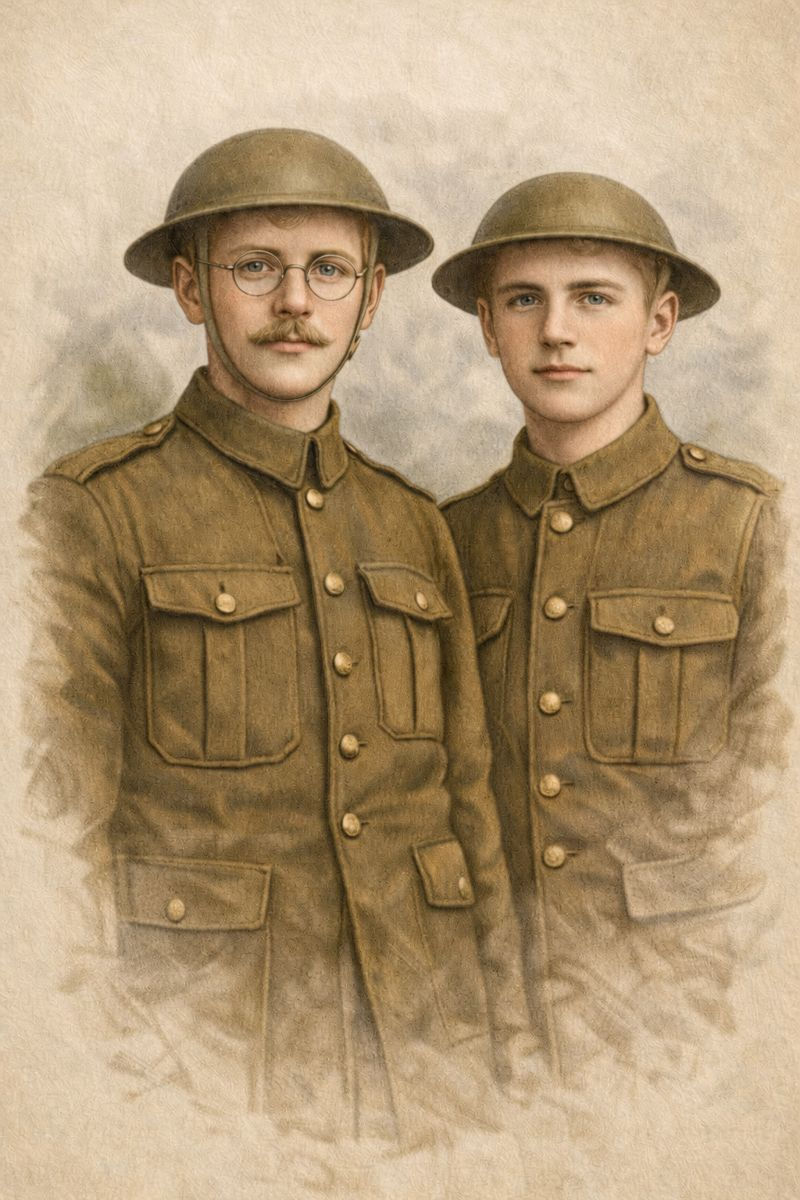
Clarence Gill
Clarence Gill is already a soldier when the war comes.
At the outbreak of the First World War, Clarence is not a boy swept up by posters and marching bands, but a trained man in uniform. He is serving with the London Regiment, later promoted to Sergeant, carrying authority that sits heavily on him even before he reaches the front. His service is not theatrical. It is methodical, disciplined, and weary long before it becomes fatal.
Before the war, Clarence works as a salesman, neat and quick, moving through London with polished boots and ink-stained fingers. He knows routine, presentation, and responsibility — skills that translate all too easily into military life. When he leaves the family home at 50 Radipole Road, Fulham, behind him, it is not with excitement, but with resolve.
The novel places Clarence in the trenches with unflinching clarity. He wakes before the whistle, boots wet and clammy despite thick socks, body exhausted, mind hovering between sleep and fear. The earth around him is saturated with mud, blood, and decay. He grips his rifle tightly, helmet pulled low, thinking not of glory, but of home — trams, electric fittings, his mother’s voice calling him down the stairs at Radipole Road.
Clarence’s death is one of the book’s most devastating moments precisely because it is so specific.
During an advance, he is badly wounded in the leg but remains alive. He is being carried to safety by medics when a mortar shell hits the stretcher, killing him and the men with him instantly. His body is later recovered by a patrol. In his pockets are the ordinary remnants of a life interrupted: a cracked leather wallet, letters folded small and kept close to his chest, spectacles bent but intact, a whistle, keys worn smooth with use, and a photograph of his family.
The recovery patrol records his name carefully: “Clarence Gill. Sergeant. London Regiment.”
There is no grave marker — only a note on a map, and the promise that his family will be told.
The letter written to his parents struggles to make truth bearable. It speaks of honour and courage, of a death without suffering — words chosen not because they are certain, but because they are all that can be offered. His belongings are wrapped carefully and tied with string, each item heavy with finality.
Clarence Gill does not return home. He becomes one of the names that reshape the family’s future, one of the absences around which the rest of life must reorganize itself.
In The Tisdalls, Clarence represents the professional soldier — steady, dutiful, and consumed by a war that had no room for steadiness. His story is not about heroics. It is about service carried through to its irreversible end.
albert Gill
Albert Gill does not begin the war as a soldier.
When the First World War breaks out, Albert is still in civilian life. He has a job, a routine, and a place within his family that has not yet been shattered by uniform and loss. Unlike his elder brother Clarence, Albert is not already serving. He watches the war arrive gradually — first as headlines, then as marching men, then as the slow tightening of expectation.
Albert thinks about joining before he acts. The book is careful here. He does not rush forward waving a flag. He hesitates. He avoids his father’s eye. He understands, instinctively, that once spoken aloud, the decision becomes irreversible.
When Clarence leaves, Albert remains behind — briefly. He shakes his brother’s hand, says little, and carries the weight of what has not yet been said. By the time the family gathers at the railway station later, that hesitation has ended. Albert has joined up. The rifleman’s number and duty settle onto him, described in the text as “like a brand new trench coat” — stiff, unfamiliar, and already heavy.
Albert goes to France with Clarence.
At the station, he hugs his mother quickly, as if too much tenderness might undo him. He tries to look brave. Everyone does. Alice fixes Clarence’s collar like she used to when he was a boy; Albert stands beside them, swallowing hard, aware that this moment is already becoming memory. When the train pulls away, Alice holds the image of both her sons leaning from the window and stores it like a photograph — because she knows, even then, that she may never see them again.
Albert’s war is shorter than Clarence’s, but no less final.
The novel does not linger on Albert in the trenches in the same way it does with Clarence. Instead, his presence is felt through absence, waiting, and dread — through Alice’s worry, through Emily’s vigilance, through the family’s growing familiarity with silence and telegrams.
When the telegram arrives, it is sudden and devastating.
It is delivered to 50 Radipole Road.
“Albert Gill. Killed in France. Fifteenth of September, 1916.”
There are no details. No explanation. No objects returned. Just the stark fact of death and the date it occurred.
Alice does not scream. She sits down and puts her head in her hands.
She has now lost both her boys.
The family enters mourning again — deeper this time, heavier with repetition. The war has taken Clarence with process and ceremony, and Albert with brutal efficiency. His death closes something permanently. It confirms that this war does not bargain, does not discriminate, and does not stop once it has begun.
Albert Gill’s story in The Tisdalls is the story of the civilian pulled inexorably into uniform, of hesitation overtaken by duty, and of a life ended with devastating brevity. He represents the thousands of men whose war is recorded not in medals or letters, but in a single line of text delivered to a family who must somehow go on.
His death reshapes Alice irrevocably. It lingers in the household long after the guns fall silent. And like Clarence, Albert does not return home — he becomes one of the names Emily thinks of when the bells finally ring for peace, and one of the absences that peace can never repair.


Comments