


Lazarus Blanks: The Moral Centre of the Novel


In a story so often framed around scandal, it would be easy to overlook the quiet figure standing behind it.
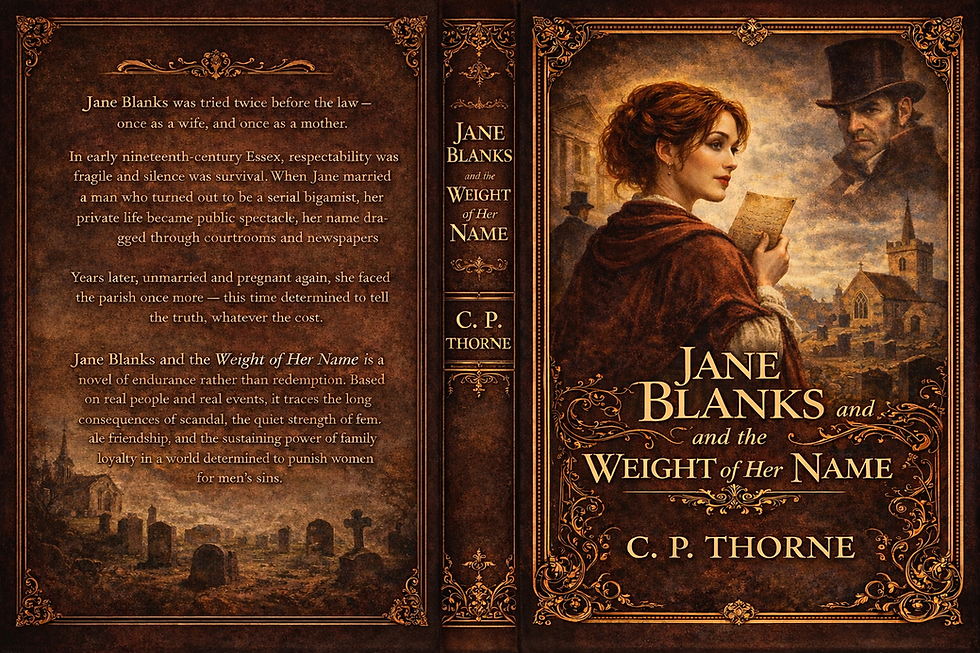
Lazarus Blanks does not command headlines. He does not dominate court transcripts. He does not appear in newspaper columns dripping with judgement. Yet, without him, Jane Blanks and the Weight of Her Name would be a very different book.
Lazarus is the moral centre of the novel.
He is not flawless. He is not sentimental. He is not progressive in the modern sense, but he is steady — and in a world designed to punish women for men’s sins, steadiness is a radical force.
A Father in a Punitive World
Victorian England was not kind to women who fell outside the narrow boundaries of sexual respectability. Illegitimacy was treated as a moral contagion, and families were often expected — even encouraged — to distance themselves from a daughter who had brought shame upon the household. Many did. Lazarus Blanks does not.
When Jane becomes pregnant as a young woman, and later when her marriage collapses into public disgrace, Lazarus does not eject her, silence her, or pretend she no longer exists. Instead, he absorbs the social cost of standing by her.
This matters more than the novel ever states outright.
Lazarus is a blacksmith — a skilled, respected tradesman — and clerk of the parish church. He understands both labour and law, both community and conscience. He knows precisely what it means to support a daughter who will be judged harshly, and he does it anyway.
That choice is not passive. It is active, costly, and deeply moral.
Masculinity Without Control
What makes Lazarus particularly compelling is that he does not respond to Jane’s situation by trying to control her.
He does not lock her away. He does not force silence. He does not rewrite her story to protect his pride.
Instead, he listens.
When Jane is faced with naming the father of her second child — a moment that will determine whether she is punished or protected — Lazarus does not instruct her on what will be easiest. He asks her what is true.
This is not the response of a weak man, nor of a man uninterested in reputation. It is the response of someone who understands that moral authority is not the same thing as social dominance.
In many Victorian novels, fathers are either tyrants or absentees. Lazarus is neither.
He remains present.
Standing in Court
One of the most important moments in the novel — and in the historical record — is Lazarus’s appearance in court during the bigamy trial of John Mackiah Collins.
Here is a man who has been deceived, embarrassed, and publicly exposed. A lesser figure might have distanced himself from the scandal, denied responsibility, or implied complicity on his daughter’s part.
Lazarus does none of these things.
Instead, he speaks plainly.
He admits he was deceived.
He admits he believed Collins.
He admits he sent his son to make enquiries and was misled.
There is no attempt to shift blame onto Jane.
That honesty costs him dignity in the eyes of the court — but it preserves something more important: his integrity.
Age, Endurance, and Legacy
Lazarus lives to ninety — an extraordinary age in the nineteenth century.
By the time he dies, he has buried children, outlived his wife, and watched his youngest daughter survive scandal that would have destroyed many families. When he is laid to rest in Little Baddow churchyard, his grave is unmarked, but his presence lingers in the novel long after his death.
He is the reason Jane survives.
Not because he rescues her, but because he refuses to abandon her.
In that sense, Lazarus represents a form of masculinity rarely celebrated in either Victorian literature or modern retellings of the past: one rooted not in authority, punishment, or reputation, but in loyalty and moral courage.
Why Lazarus Matters
This novel is not only about a woman who tells the truth.
It is also about a man who makes it possible for her to do so.
Lazarus Blanks reminds us that history is not shaped solely by villains and victims, but by those who quietly refuse to participate in cruelty — even when cruelty is expected of them.
In a book filled with courts, parishes, and newspapers eager to judge, Lazarus stands apart.
He does not silence.
He does not withdraw.
He stays.

Comments