


MEET BERT AND LIZZIE TISDALL

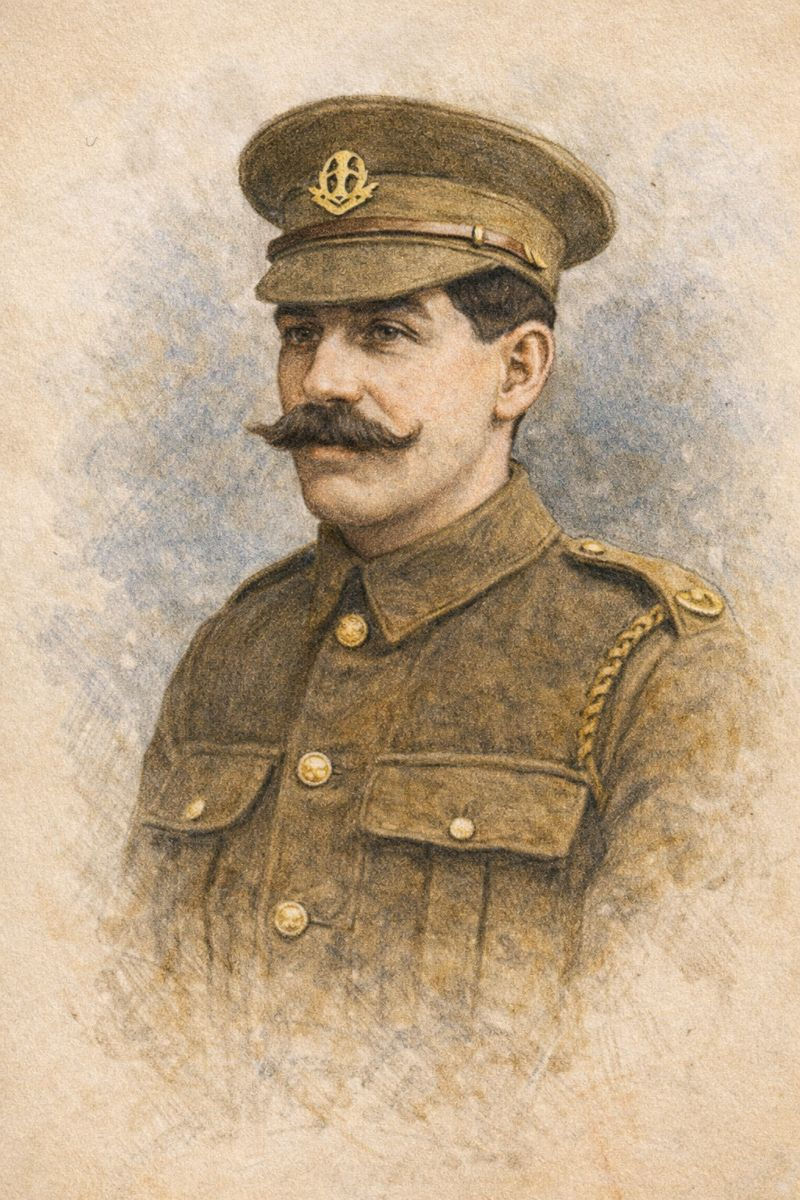
Bert TISDALL
Son · Soldier in India · A Railwayman at heart
Bert Tisdall’s first love is Steam Railways.
Long before the war, before India, before responsibility hardens him, Bert is captivated by trains and railways — the power of engines, the precision of timetables, the promise of movement and connection. Railways represent order, progress, and purpose in a world that often feels unpredictable. They are the one thing that consistently excites him.
When the First World War comes, Bert joins the army and is sent to India, far from London and far from the rhythms of family life. Unlike his brothers whose lives are shaped by Europe and home-front loss, Bert’s war unfolds within the vast, complex machinery of empire.
India does not remain a backdrop.
Bert is fascinated by the railways there — not as symbols of British control, but as living systems run by skilled men whose knowledge far exceeds his own. It is through this fascination that he forms a deep and consequential friendship with Ravi, an Indian engineer working within the railway system.
Ravi becomes Bert’s guide — technically, culturally, and morally.
Through Ravi, Bert begins to understand the realities beneath imperial order: the inequalities, the compromises, the quiet injustices embedded in daily operations. What begins as professional curiosity becomes ethical involvement. Bert listens. He learns. And, crucially, he does not look away.
This is where Bert’s character develops further.
He becomes involved in situations far beyond what he expected, and is forced to choose between obedience and conscience. The novel is clear: Bert is not a radical by nature, nor does he seek conflict. But when confronted with wrongdoing, he stands up for what is right, even when doing so carries personal risk.
His war is not fought in trenches, but in decisions.
India changes Bert permanently. He returns older, more serious, and less certain of easy answers.
The boy who loved engines becomes a man who understands systems — and how easily they can be misused.
Lizzie TISDALL
Wife · Anchor · The cost of loving a changed man
Lizzie marries Bert before fully knowing what distance and war will do to him.
Her role is not dramatic, but it is demanding. While Bert is away, Lizzie lives with uncertainty — letters delayed, information sparse, worry constant. She waits, manages, and holds space for a husband whose inner life is increasingly shaped elsewhere.
When Bert returns, Lizzie recognizes that something fundamental has shifted.
He is still loving, still principled — but quieter, more inward, and marked by experiences he cannot easily articulate. Lizzie does not push him to explain. She understands instinctively that some things must be absorbed rather than spoken.
Lizzie’s strength lies in acceptance without erasure.
She supports Bert not by smoothing over his convictions, but by allowing him to be the man India has shaped — even when that complicates their life together. She does not demand simplicity where none exists.
Within the Tisdall family, Lizzie remains steady and observant, aware that Bert carries a different kind of war inside him. She becomes the point of continuity between the man who left and the man who returned.
Why Bert and Lizzie Matter
Bert and Lizzie’s story widens The Tisdalls beyond Britain and beyond the familiar narratives of trench warfare.
Bert shows how war intersects with empire, industry, and conscience
Lizzie shows the emotional labour required to live alongside a man changed by moral awakening
Together, they represent a strand of the First World War often overlooked: the war fought in distant places, through infrastructure, loyalty, and difficult choices — and the marriages that had to absorb its consequences.
Bert Tisdall does not come home unchanged. Lizzie does not ask him to.
That, quietly, is their strength.


Comments