


MEET FRED TISDALL AND HIS FAMILY
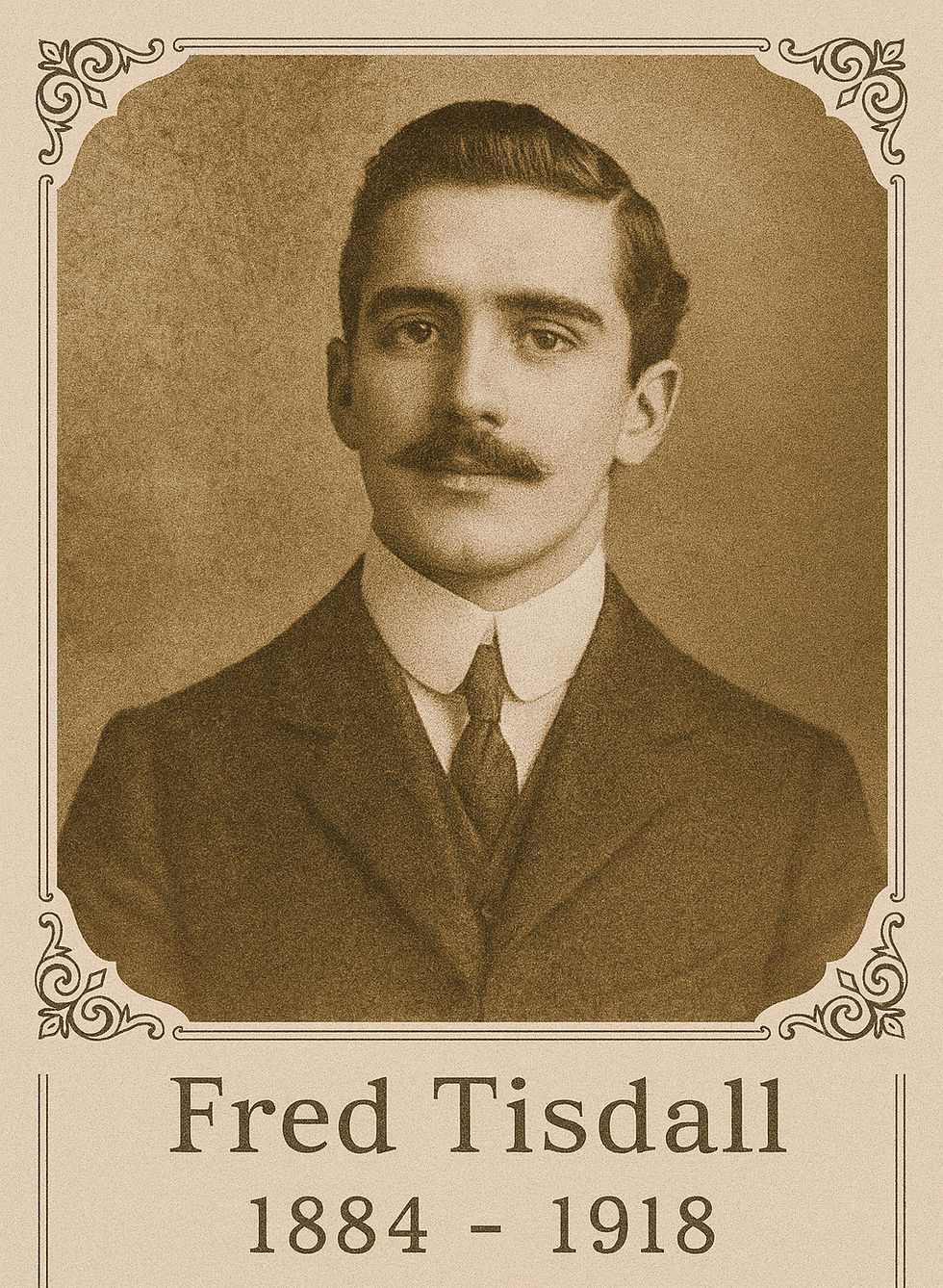
Fred Tisdall is a man who loves precision.
Long before the war, he is drawn to clocks and watches — to gears, springs, faces marked by numbers that promise order and reliability. Time, to Fred, is something that can be measured, repaired, and understood. He takes comfort in mechanisms that behave as expected, that can be coaxed back into working with patience and care.
This love of precision shapes his character. Fred is steady, thoughtful, and quietly absorbed by detail. He is not impulsive. He believes in things that last.
When the First World War comes, Fred becomes a soldier — and with that, his relationship to time changes forever. Days stretch unpredictably. Waiting replaces rhythm. The certainty he once found in clocks gives way to the long, suspended hours of military service.

Fred is sent to Salonika, Greece, serving on a front often forgotten in popular memory. The conditions are harsh, the climate punishing, and the sense of distance from home profound. Letters take weeks. News arrives late. The war feels endless even as the rest of Europe begins to imagine its conclusion.
Fred does not die in battle.
He dies after the Armistice has been signed — when peace has officially returned, but danger has not yet released its grip. His death comes cruelly late, after survival has already been promised in name if not in fact.
He never makes it home.
Lily Tisdall
Wife · Mother · Keeper of absence

Lily Tisdall’s life is defined by waiting — and then by permanence.
She marries Fred knowing his nature: his quiet absorption, his love of detail, his steadiness. When he goes to war, she holds the home together with the expectation that it is temporary — that survival will bring return.
Fred comes home once.
On his final leave, Lily conceives their son Edgar Tisdall. Fred returns to service knowing that a child has been placed quietly into the future.
What he doesn't know is that he will never see Edgar.
When news of Fred’s death arrives, it shatters not only Lily’s present, but her sense of time itself. The future she had imagined collapses into something narrower and lonelier. Yet Lily does not unravel. She absorbs the loss and reshapes her life around it.
She never remarries.
This is not framed as martyrdom or romantic devotion, but as a decision rooted in loyalty, memory, and the practical reality of raising children alone. Fred’s absence becomes a constant presence — not spoken of endlessly, but never erased.
The Children
Lives shaped by someone they never knew
Fred and Lily’s children grow up with a father who exists through stories, objects, and silence.
Edgar Tisdall
Edgar is born into a world where his father is already gone. Fred exists for him only through photographs, a name, and the knowledge that he was wanted. Edgar grows up aware that his life began in a brief moment of return — a fragile bridge between war and peace that did not hold.
Connie Tisdall & Betty Tisdall
Connie and Betty are old enough to feel loss without fully understanding it. Their grief is quieter, but no less enduring. The absence of a father shapes their confidence, their expectations, and their sense of safety in the world. They grow up careful, alert to the way life can be altered without warning.
Both daughters carry the weight of war not through memory, but through inheritance — the emotional legacy of a death that reshaped their childhood.


Why Fred and Lily Matter
Fred Tisdall’s story is one of the most devastating in The Tisdalls precisely because it arrives too late.
He survives the war
Peace is declared
And still, he does not return
Lily’s story is its counterpart — a life lived forward with dignity, endurance, and restraint. Together, they represent the families for whom the Armistice did not mean relief, but a different kind of reckoning.
Fred measured time carefully. The war took it from him anyway.
Lily — quietly, steadfastly — carried what remained.


Comments