


MEET GLADYS GILL AND ERIC RANDOLPH

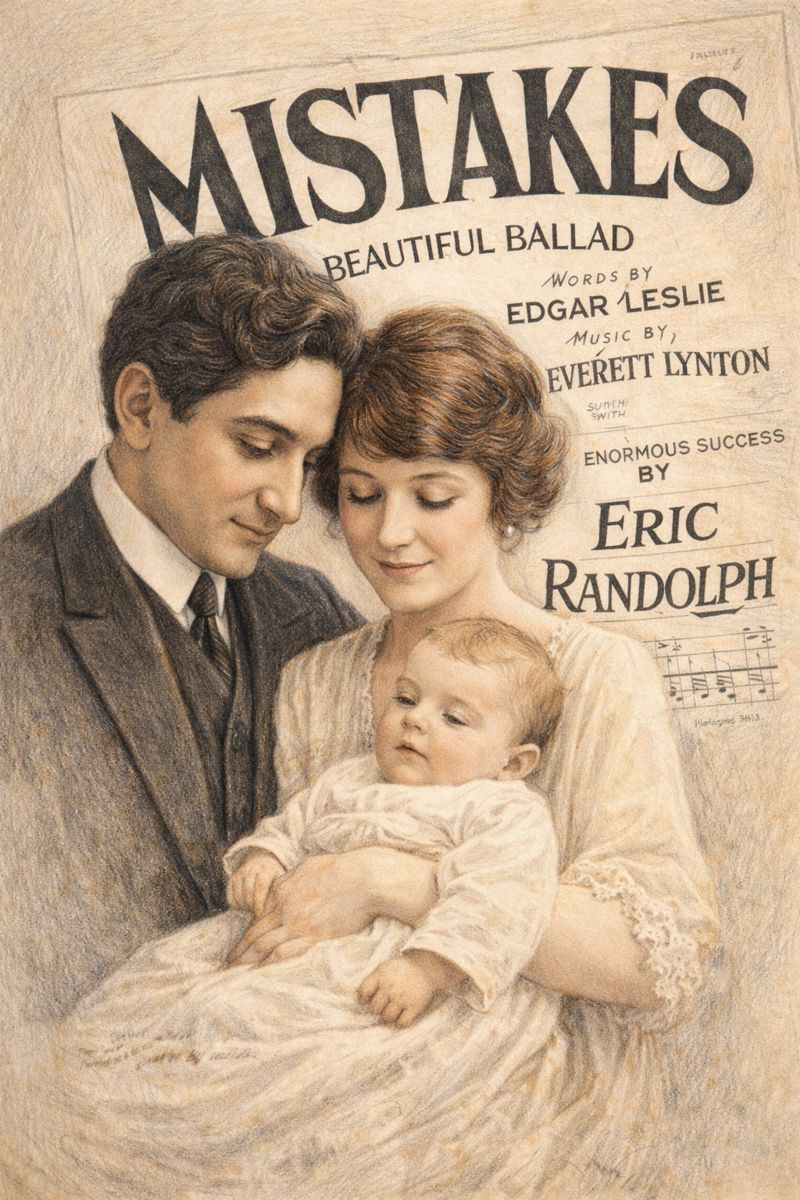
Gladys Gill begins her adult life with movement, rhythm, and promise.
As a young woman, mentored and guided by her Aunt, Madge Tisdall, Gladys works as a music-hall dancer, confident in her body, disciplined in her craft, and accustomed to the demands of rehearsal and performance. The stage gives her independence and identity — something she has earned rather than inherited. She understands the music hall from the inside: the physical toll, the late nights, the necessity of charm backed by endurance.
Marriage changes everything. When Gladys marries Eric Randolph, she gives up her stage career. This is not a failure, but a decision shaped by love, expectation, and the belief that stability will offer something the stage cannot. She steps away from performance and into domestic life, carrying with her the habits of discipline and self-containment she learned as a dancer.
Motherhood briefly gives that choice meaning.
Gladys and Eric have a son, Ivan — a child deeply loved and carefully protected. For a time, Ivan anchors their marriage. He is the centre around which Gladys organises her life, and the proof that sacrifice has led to something tangible and alive.
Then, in 1918, the Spanish influenza epidemic arrives.
Ivan dies at four years old.
The novel treats this loss with devastating restraint. There is no melodrama — only the quiet collapse of a future Gladys believed she had secured. Ivan’s death does not merely break her heart; it unravels the marriage itself. What little stability Gladys has left disappears with him.
After Ivan’s death, Gladys finds herself alone in ways that go beyond grief.
Eric is frequently away working, his career keeping him absent from the emotional and physical space of the marriage. Unbeknownst to Gladys at first, he has conducted an affair with an Italian opera singer — a relationship that exists entirely outside her knowledge while she mourns their child.
When the truth emerges, it lands on a woman already hollowed by loss.
The marriage does not survive.
Eric goes on to meet someone new. He has another child. Only then does he formally ask Gladys for a divorce, sealing the end of a life Gladys had already watched disintegrate.
Gladys’s story does not end there.
In time, she meets someone else. She remarries, choosing companionship over performance, endurance over spectacle. She leaves London and ends her days in Cornwall, far from the stages where her life began — a woman shaped by art, love, grief, and survival.
Gladys Gill represents a generation of women whose lives were reshaped by forces they did not control — war, disease, marriage, and male freedom — and who nonetheless found a way to continue, rebuild, and choose again.
Eric Randolph
(born Randolph Epstein)
Eric Randolph is a man of talent, movement, and contradiction. He is not an invented character - he was a real life Tenor and performer.
Born Randolph Epstein, son of Rabbi Moses Aaron Epstein, he comes from a Jewish family where music is inheritance as much as profession. He is trained, disciplined, and already experienced by the time he enters Gladys’s life — a performer shaped by touring, applause, and absence.
Eric’s career demands constant travel.
Even during marriage, he is often away working, moving between engagements and cities, his life governed by contracts and performance schedules rather than domestic routine. He does not abandon Gladys deliberately, but neither does he fully inhabit the marriage. Work becomes distance.
His affair with an Italian opera singer is not portrayed as villainy so much as inevitability — a consequence of touring life, opportunity, and emotional detachment. Crucially, it occurs without Gladys’s knowledge, while she has already sacrificed her own career and is bound to the home by motherhood.
After Ivan’s death, Eric does not return in the way Gladys needs.
Instead, he moves forward. He forms a new relationship. He has another child. Only then does he formalise what has already happened emotionally by asking Gladys for a divorce.
Eric survives the marriage, intact in career if not in conscience.
In The Tisdalls, Eric Randolph represents a particular kind of Edwardian male privilege: the ability to move on, to begin again, to build a second family while the first quietly dissolves behind him.
Why Their Story Matters
Gladys and Eric’s marriage is one of the novel’s most painful truths.
A woman gives up her career for love.
A child briefly holds a marriage together.
Disease destroys what war has already weakened.
A man moves on.
A woman must rebuild from loss, betrayal, and displacement.
Their story is not sensationalized. It is observed, and in that observation lies its power.
Gladys survives not by reclaiming the stage, but by choosing a quieter ending on her own terms.

Comments