


meet madge tisdall

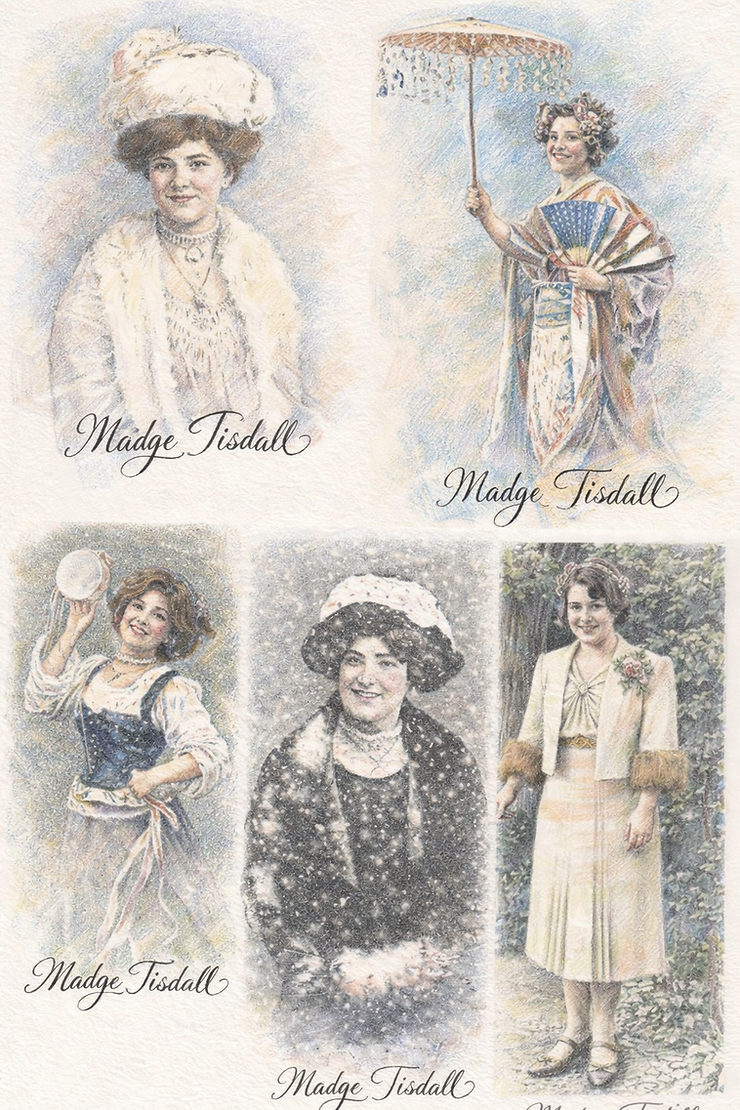
Madge Tisdall is drawn to the light.
From an early age, she notices things others overlook — the way a room changes when music begins, the way faces soften in an audience, the electricity that passes between performer and crowd. Where her parents value steadiness and restraint, Madge feels pulled toward expression, movement, and the thrill of being seen.
She is not careless or foolish, despite how easily such labels are applied to girls like her. Madge is observant, intuitive, and quick to read the emotional temperature of a room. She understands people instinctively — what they want, what they expect, and what they will pay to be entertained. This sensitivity, which might have made her an excellent hostess or shopkeeper, instead finds its natural home on the stage.
Music hall offers Madge something domestic life cannot: possibility. It is noisy, colourful, unpredictable — a world where class boundaries blur and a woman can briefly command attention on her own terms. On stage, Madge feels composed and certain; off it, she feels the tension of expectation pressing in again.
Yet Madge is never naïve about the cost of visibility. She understands that respectability is fragile, particularly for working-class women who step beyond prescribed roles. She learns quickly how closely performers are watched, how easily admiration can turn to judgement, and how little margin for error is allowed. Every choice she makes is weighed against reputation — her own and her family’s.
Madge’s relationship with her parents is affectionate but slightly strained. She loves her family deeply and feels loyalty to them, yet she resists the life laid out before her. Sidney’s quiet authority and Emily’s careful vigilance both loom large in her thinking. She does not wish to disappoint them — but nor can she ignore the pull of a life that feels fully her own.
What makes Madge compelling is not rebellion, but negotiation. She does not reject her upbringing outright; instead, she attempts to stretch it, testing how far it can bend without breaking. She learns to compartmentalise — dutiful daughter in one world, performer in another — and carries the emotional weight of that division with increasing awareness.
Madge represents a generation of women standing at the threshold of modernity. She is shaped by Victorian values, yet tempted by Edwardian freedoms. Her story captures a moment when new forms of independence were becoming visible, but not yet secure — when ambition carried both exhilaration and risk.
In The Tisdalls, Madge embodies the excitement and uncertainty of change. Through her, we see how performance offered women not just income, but identity — and how the price of that visibility was often paid quietly, behind the scenes.


Comments