


Victorian Sensation Fiction and the Silencing of Women


Victorian sensation fiction was obsessed with women.
Their bodies.
Their secrets.
Their marriages.
Their crimes.
Their silences.
Emerging in the 1860s, sensation fiction brought scandal out of the shadows and into the drawing room. It invited respectable readers to thrill at adultery, bigamy, deception, and female transgression — all while insisting that such things were rare, shocking, and safely contained within fiction.
Yet beneath the melodrama lay a deeper contradiction: sensation fiction gave women centre stage, but often denied them control of their own narratives.
This tension sits at the heart of Jane Blanks and the Weight of Her Name.
What Is Sensation Fiction?
Sensation fiction is not simply melodramatic Victorian storytelling. It is a genre born of anxiety.
Rapid urbanization, shifting class boundaries, and increasing visibility of women in public life unsettled mid-nineteenth-century Britain. Sensation fiction responded by staging domestic life as a site of danger. The home was no longer safe. Marriage was no longer stable. Respectability could be forged — or faked.
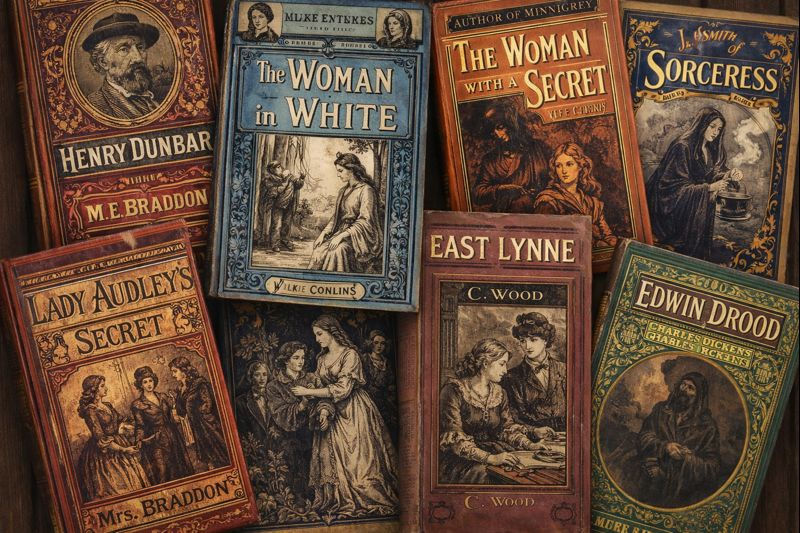
Novels such as Lady Audley’s Secret and The Woman in White revolve around women who disturb the social order simply by existing beyond expectation. These women are watched, investigated, diagnosed, and judged — often by male narrators who insist upon control even as they are fascinated by what they observe.
Sensation fiction thrives on exposure.
Exposure is not the same as voice.
Female Authors, Male Frames
One of the most revealing aspects of sensation fiction lies in the difference between how women and men wrote women.
Mary Elizabeth Braddon’s novels, particularly Lady Audley’s Secret, present female transgression as a response to constraint. Braddon’s women are calculating, frightened, ambitious, and often desperate — not because they are innately immoral, but because the social structures surrounding them leave few alternatives.
By contrast, Wilkie Collins’s women are frequently filtered through male consciousness. Even when sympathetic, they are framed as problems to be solved, mysteries to be deciphered, or moral puzzles requiring explanation.
Both approaches expose injustice.
Only one allows women to speak back.
This distinction shaped my academic interest in sensation fiction and continues to shape my creative work.
Silence as Social Control
Victorian society was not threatened by women who sinned.
It was threatened by women who spoke.
Real women involved in scandal — especially those named in court — were rarely allowed complexity. Newspaper reports described their appearance, speculated about their morals, and reduced their lives to cautionary tales. Their interior lives were irrelevant.
Sensation fiction mirrored this dynamic.
Women were displayed, analyzed, sensationalized — but rarely granted narrative authority.
This is where historical fiction must intervene.
Jane Blanks: A Sensation Heroine Who Was Real
Jane Blanks lived the reality sensation fiction dramatized.
She was publicly named in a bigamy trial.
Her sexual history was dissected in court and press.
Her body became evidence.
Her credibility was repeatedly questioned.
However, Jane did something sensation fiction rarely allows its heroines to do: she told the truth twice — knowing full well it would cost her.
In writing Jane’s story, I was acutely aware of the genre’s legacy. This novel does not seek to recreate Victorian sensation fiction wholesale, but to respond to it.
What happens if we take the scandal seriously — but refuse to sensationalize it?
What happens if we allow a woman like Jane not merely to be observed, but to reflect?
What happens if silence is broken not for spectacle, but for survival?
Writing Against the Grain
Jane Blanks and the Weight of Her Name draws deliberately on the architecture of sensation fiction — courts, secrets, bigamy, public exposure — while resisting its most damaging habits.
Jane is not a mystery to be solved.
She is not a spectacle to be consumed.
She is not redeemed by punishment or erased by death.
She lives.
The novel asks readers not to judge her, but to sit with the consequences of judgement itself — and to recognize how often history mistakes silence for morality.
In that sense, this book is less a homage than a correction.
It insists that behind every sensational headline was a woman who had to keep living after the paper was folded away.


Comments